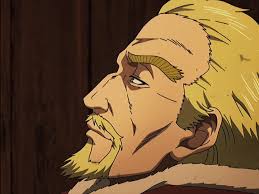
Askeladd, one of the most complex characters in Vinland Saga, utters one of the series' harshest truths: "Everyone is a slave to something." This statement is not just a cynical comment on the human condition, but a deep dissection of determinism and will. In a world of Vikings where freedom is measured by the strength of the sword, Askeladd reveals that even the most powerful warrior is bound by invisible threads he cannot cut.
His philosophy resonates with the thought of Friedrich Nietzsche, particularly the idea of the "will to power" and the critique of slave morality. Askeladd despises those who blindly follow the traditions or desires of others, yet recognizes that he himself is a slave to his own hatred and his ambition to see Wales free. Freedom, for Askeladd, is an illusion that men pursue while being dragged along by their passions, their debts, or their own blood.
Determinism in Askeladd manifests in his understanding of history and politics. He sees the world as a machine that devours the weak and corrupts the strong. He does not believe in redemption, but in the strategic use of people. For him, every individual has a price or a weakness that turns them into a tool. This Machiavellian vision is, in reality, a form of self-protection: if everyone is a slave, then manipulating them is simply understanding the rules of the game.
However, there is a fascinating contradiction in his character. Despite his cynicism, Askeladd maintains a secret idealism. His loyalty to the legend of Artorius and his desire to find a true king for Wales show that he is a slave to a hope that he himself considers foolish. This is where we connect with the Nietzschean concept of "Amor Fati": the acceptance of fate, but also the internal struggle to give one's own meaning to that slavery.
In modern society, the chains Askeladd speaks of have changed shape but not essence. We are no longer slaves to feudal lords in the literal sense, but to algorithms, social validation, consumption, or the fear of failure. Askeladd's analysis invites us to ask: what are we slaves to today? Recognizing one's own slavery is, paradoxically, the first step toward authentic freedom, however limited by our nature it may be.
Askeladd uses Thorfinn as his primary tool, exploiting the young man's hatred for his own ends. This relationship is the ultimate example of his philosophy. Thorfinn believes he pursues revenge of his own will, but Askeladd knows Thorfinn is a slave to his father's ghost. In the end, Askeladd dies not as a slave, but as someone who chose his own chain: sacrifice for a future he would not see.
Ambition, in this essay, is analyzed as a driving force that often becomes a prison. Those who pursue power end up being servants of power itself. Askeladd observes kings and generals and sees men who cannot sleep, who cannot trust, and who are trapped in an infinite cycle of violence. True freedom would require giving up what we desire most, something very few are willing to do.
From an existentialist perspective, Askeladd's phrase suggests that existence precedes essence, but that essence is weighted with facticity: the circumstances we do not choose. We are born into a time, a place, and with a specific blood. Askeladd, half-Danish and half-Welsh, is a slave to that duality. His life is a constant attempt to reconcile both parts through conflict, demonstrating that even identity can be a form of servitude.
The concept of "freedom" in Vinland Saga evolves through Askeladd. He is the bridge between the old world of honor and blood and the new world of politics and strategy. His death is his final act of freedom, the moment he breaks all his chains to allow others (Canute and Thorfinn) to follow different paths. It is a reminder that, although we are all slaves, the quality of what we choose to serve defines our greatness.
Finally, this analysis leads us to the conclusion that Askeladd's philosophy is a mirror of our own struggle for autonomy. In a system that seeks to categorize and use us, awareness of our own limitations is our best weapon. Askeladd does not ask us to be free, because he knows it is impossible; he asks us to be aware of who or what holds our leash.
-Is love a virtue or a systemic weakness?
Next analysis: Canute's Philosophy →