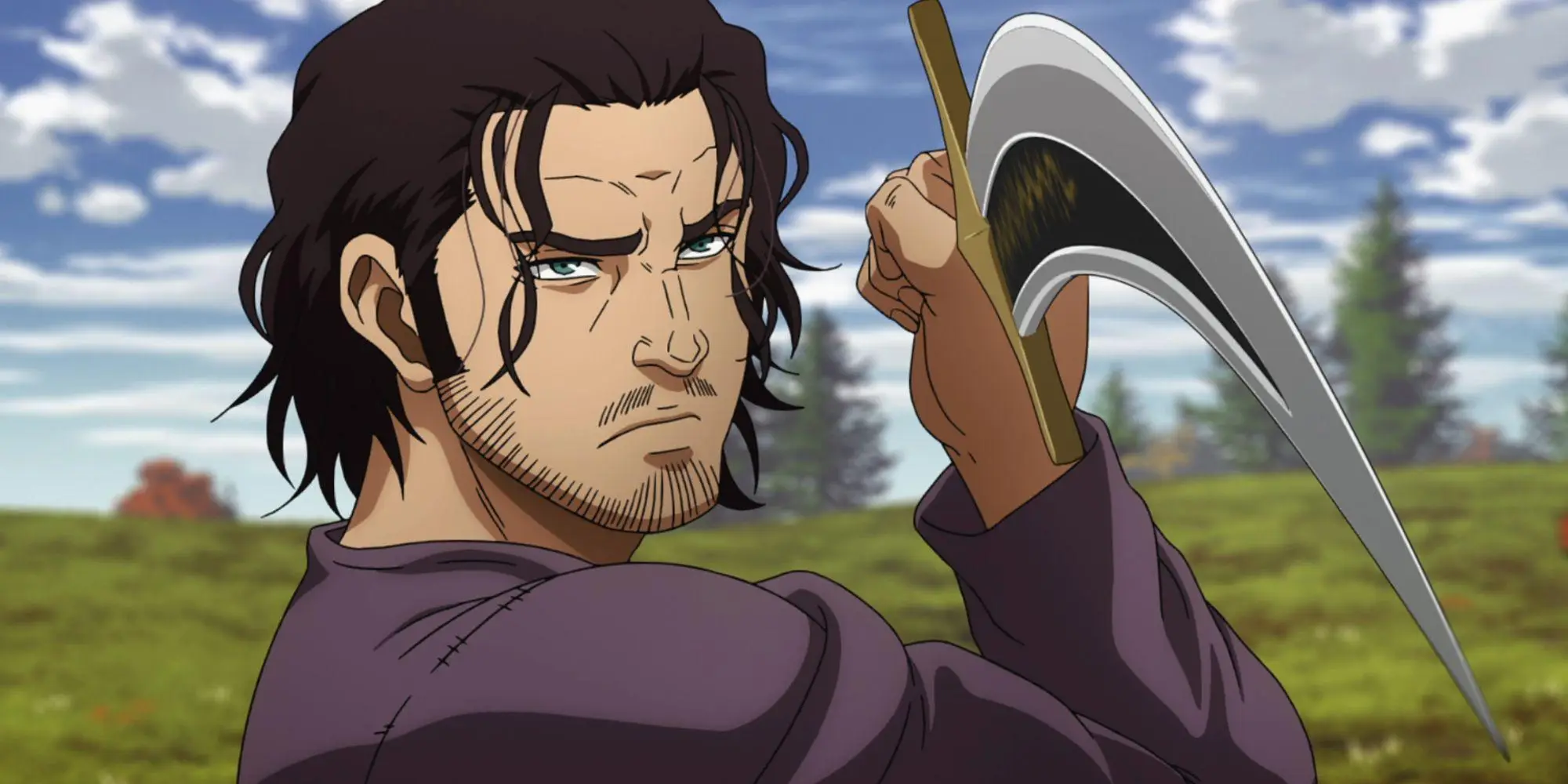
In the violent crucible of the Viking age, male identity was inextricably linked to the capacity to exert violence. A man was "worth" as much as the number of heads he had severed or the amount of gold his axe had claimed. However, during the Ketil's Farm arc, a character emerges who shatters this paradigm from within: Snake. His presence serves as a bridge between the savage warrior and the civilized man, and his deepest lesson is summarized in a fierce critique of the metrics of steel.
When Snake interacts with an empty, will-less Thorfinn, he doesn't see a weak slave; he sees a man who has made the error of believing his usefulness ended when he dropped his daggers. Norse society taught that a warrior without a sword is a "nobody." Snake, with a background hinting at a past in the Varangian Guard of Constantinople, possesses a much broader worldview. He understands that combat technique is merely a tool, not the core of one's being. By challenging Thorfinn's perception, Snake plants a seed of humanism in a soil fertilized by centuries of blood.
"Do not measure a man's worth by his skill with a sword; the weight of his soul is measured by what he protects when he has nothing to gain."
This reflection invites us to analyze the concept of honor. For most antagonists in Vinland Saga, honor is an external currency: something earned in the eyes of others through domination. For Snake, worth is an internal quality. He protects Ketil's farm not out of blind loyalty to money, but due to a personal code of order and responsibility. Unlike Thorkell, who seeks war for the pleasure of chaos, Snake uses force as a necessary evil to maintain the peace of those who cannot defend themselves. He is, in essence, a pragmatic Stoic.
The impact of this philosophy on Thorfinn's growth is massive. It helps the protagonist understand that his "redemption" does not consist in ceasing to be strong, but in redefining what that strength is for. If a man's worth is not in his sword, then a man can be valuable by tilling the earth, caring for a sick friend, or simply existing with integrity. This demystification of violence is what allows Thorfinn to eventually aspire to be a "true warrior"—someone who does not need enemies to validate themselves.
In conclusion, Snake acts as the necessary mirror for the reader (and Thorfinn) to question their own metrics of success and value. In a modern world that often rewards aggressive competitiveness and external status, Snake's warning remains relevant: what makes us valuable is not our ability to "strike" the world, but the depth of our character and the righteousness of our actions in the dark. Real worth does not shine on the edge of a weapon, but in the steadfastness of a soul that knows who it is without needing to oppress another.